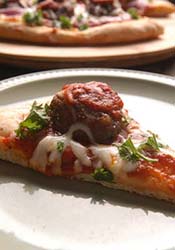
Photo by Josh Keown
Meatballs, which have been around for hundreds of years and were once considered peasant goods, have gone mainstream. In fact, one Chicago restaurateur has opened a restaurant called “The Ball Room.” Yes, meatballs of various style (and shape) served every which way are the mainstays of the menu.
Let me put it this way: who doesn’t like a meatball? And this way: who doesn’t like pizza? Ah, the light bulb just went on. Meatball pizza.
Of course there are many suppliers jumping to sell you ready-made meatballs, so you should sample those out to see which works best for you. On the other hand, I’m offering two basic recipes for making meatballs in-house. The first recipe, “Mamma’s Magnificent Meatballs,” is a big batch deal. But once made and cooked, they can be frozen and kept for later use. The second recipe is similar in style, but it is more or less a test recipe so that you can get the hang of the process.
Just to keep the ball rolling, I am giving you a couple of tweaks that will allow you to offer something a bit different — lamb meatballs and turkey meatballs. The best way to market your meatball pizza is to draw attention to it. Come up with a clever slogan like “We are having a ball!” (groan) or “Try one of our specialty meatball pizzas.” You can also play up the idea that a turkey meatball pizza would be a healthier option. Let’s get rolling.
Mamma’s Magnificent
Meatballs
Yield: about 100 2-ounce meatballs
8 pounds lean ground beef
2 pounds ground pork
¼ cup finely chopped or crushed garlic
2 medium-size onions, finely chopped
1 cup grated Parmesan cheese
½ cup grated Romano cheese
1 cup finely chopped flat-leaf parsley
5 cups bread torn from day-old Italian or French bread, soaked in milk then squeezed dry
7 eggs, lightly beaten
3 teaspoons salt
4 teaspoons black pepper
4 teaspoons dried oregano, crumbled
Combine all the ingredients in the order listed. Mix by hand thoroughly.
Form the meatballs — a bit larger than a golf ball — by rolling the meat between the palms of your hand.
Lay a thin film of vegetable oil in a large skillet. Sauté the meatballs over medium-high heat in batches until they are cooked through, turning them frequently to brown evenly.
Once cooled, the meatballs can be used at once or frozen for later use
Cook’s Notes: Vary the size of the meatballs for the application — sandwich, pizza, spaghetti and meatballs. The meatballs can be baked in the oven (450 F) instead of sautéed. Set a pizza screen on top of a pizza pan. Spray the screen with vegetable oil. Arrange the meatballs on the screen and bake until cooked through. Cooking time will vary relative to the type of oven being used.
Basic Meatball Recipe
Yield: 18 meatballs, each about 2 inches in diameter
1 pound ground pork
1 pound ground beef
1 cup cubed day-old Italian bread
½ cup milk
1 teaspoon each dried oregano and dried basil, crumbled
¼ cup minced flat-leaf parsley
¼ cup grated Romano cheese
1 large egg, lightly beaten
In a large mixing bowl, combine the pork and beef. In another bowl, soak the bread in the milk until it is saturated. Squeeze the bread and drain off excessive milk. Tear the bread into small pieces and add it to the meat. Add the remaining ingredients. Mix thoroughly and form into meatballs.
Arrange the meatballs on a sheet pan fitted out with a drain tray (or use a spray-coated pizza screen). Bake the meatballs until cooked through. Set aside. (Can be prepped ahead and held, covered, refrigerated, for up to four days. Or frozen.)
Now, on to the meatball pizza. Take note of these suggestions:
Do not try to use a large meatball. The crust may not carry the weight, and your food costs will be too much to deal with.
You can use smaller meatballs as they are but, again, don’t load the crust down.
A better option is to slice the meatballs in half horizontally. Put the flat side of the meatball down, the domed side up.
Another option is to slice the meatballs (the larger size) into “coins” and use those on the pizza in the same manner as, say, pepperoni.
How many meatballs to use is relative to the pizza size. Use common sense. Not too many, not too little.
Spread pizza sauce over the crust. Sprinkle some grated Romano cheese over the sauce. Sprinkle on some grated mozzarella (or other grated cheese). Arrange the halved meatballs over the cheese. Sprinkle on additional cheese. For example, a 14-inch pizza would take about 8 ounces of grated mozzarella. Use 4 ounces for the first layer of cheese; 4 ounces for the second layer of cheese. Bake.
Three Great Variations
Lamb meatballs. In the “Basic Meatball” recipe, replace the pork with ground lamb. Replace the oregano with ½ teaspoon ground cumin. Replace the basil with ½ teaspoon ground cinnamon.
Turkey meatballs. In the “Basic Meatball” recipe, replace the pork AND the beef with ground lean turkey, and add 1 teaspoon ground or crushed fennel seeds to the recipe.
Great Balls of Fire. Spice up a meatball pizza by adding cayenne pepper, to taste, to the basic meatball recipe. If you take this route, after mixing all the ingredients, test fry some of the meat and adjust the spicy-heat accordingly.
Pat Bruno is Pizza Today’s resident chef and a regular contributor. He is the former owner and operator of a prominent Italian cooking school in Chicago and is a food critic for the Chicago Sun-Times.

Dave, I need to trim costs considerably in just about every facet of my business. Where do I start? I can’t afford to cut quality of my product, I know, but I can’t afford not to make cuts everywhere else.
Peter White
San Diego, California
Peter, I feel your pain. And I’m glad you know right off the top that the one area you can’t touch is your quality. Substitute a lesser quality cheese or meat topping, and you will suffer for it immensely.
I have an outline I call “Death by a Thousand Cuts.” Sometimes, there are areas where the fat needs to be trimmed. But I see plenty of operations get a little too happy with the knife and do permanent damage (or worse).
Run down this checklist and see what improvements can be made off of it before you start slashing everything in the building.
1. Plug all holes in cash handling procedures. Intentional and unintentional cash shortages are avoidable. Institute a zero tolerance on cash shortage policy.
2. Portion control your cheese.
3. Become a menu-engineering
expert. You must know which menu items are producing the most and least profitability. Promote the stars.
4. Know your exact entrée costs.
5. Examine a profit and loss statement (P&L) weekly.
6. Re-price and re-print your menus and flyers at least twice a year. Quarterly is even better.
7. Get an energy audit performed by your utility provider.
8. Shop your insurance policies. You are most likely underinsured. In fact, it’s quite possible that you are one incident away from financial ruin.
9. Set up a forced savings plan. Put what you can each week from checking into savings.
10. Explore catering as an additional revenue source.
11. Get yourself out of the “employee owner” routine and understand your position as CEO of your pizza company. In other words, work on your business, not in it.
12. Think in percentages: food cost; labor cost; prime cost; occupancy cost; income before taxes depreciation and amortization.
13. Develop a marketing strategy and a marketing budget.
14. Decide, right now, once and for all, whether you’re going to be the lowest price guy in your town or the highest priced, highest quality producer in your town. Get off the fence.
15. Try to negotiate a prime vendor agreement with your distributors. In this type of agreement, you are put on a cost-plus pricing model and you get the right to audit prices from time to time. Just make sure you’re purchasing at least 85 percent of your food and supplies — if not a higher percentage — from the supplier with which you are going to enter into this agreement.
16. Lastly, over-train and cross-train your staff in order to maximize their contributions to your company. u
Big Dave Ostrander owned a highly successful independent pizzeria before becoming a consultant, speaker and internationally sought-after trainer. monthlycontributor to Pizza Today.
Flip to page 20 and read our monthly “Man on the Street” column by Scott Wiener. Scott, as avid a pizza fan as you’ll ever meet, has recently been obsessed with pizza boxes. So obsessed, in fact, that he has begun collecting boxes from pizzerias all over the world. I’ve had a look into his pizza box vault, and it’s impressive. Talk about a smorgasbord of colors and graphics!
Sadly, after embarking on this adventure, it did not take Scott long to realize that the United States, by and large, has the worst pizza boxes in the world, graphically speaking. There are far too many pizzerias out there using very generic boxes with clip-art quality graphics and no customized branding.
What a missed marketing opportunity.
There are plenty of great ones here in the States, too, as Scott discovered while roaming the International Pizza Expo show floor last March. What Scott proposes in his column this month is simple, and I am behind it 100 percent. Let’s beautify America’s pizza boxes! I can assure you that going from bland to “bam!” is well worth the effort. A well-thought-out pizza box is a marketing basic that elevates your image. If you aren’t yet on this bandwagon, hop on now and distinguish yourself before your competitor across the street beats you to the punch.
While we’re on the topic, I’d like to see YOUR pizza box. So please mail one to my attention at the address below. We’re going to photograph the boxes we receive — the really good ones, anyway — and add the images to our photo gallery at PizzaToday.com. You might even see a picture of your box in an upcoming issue of Pizza Today. So get your best design ready, and then send it to me ASAP.
Mail your boxes to my attention at:
Pizza Today
908 S. 8th St., Suite 200
Louisville, KY 40203
Best,
Jeremy White, editor-in-chief
jwhite@pizzatoday.com

Q: In looking at different methods of dough management, some call for allowing the dough balls to rest at room temperature for an hour or more, while others say to take the dough directly to the cooler without any room temperature rest period. Does it really make a difference?
A: Yes, it does make a difference. When dough balls are allowed to rest at room temperature before going into the cooler they begin to ferment, becoming less dense. As a result, the dough becomes a better insulator, so when the dough goes into the cooler it is now more difficult to cool uniformly. In some cases, especially with larger/heavier weight dough balls, the dough may never cool down sufficiently to control the rate of fermentation so the dough “blows” in the cooler, resulting in a total loss.
Another problem with allowing the dough to rest at room temperature prior to going into the cooler has to do with the temperature of the dough as well as the actual time the dough is allowed to remain at room temperature. For example, if the dough is a couple degrees warmer than desired, or targeted, the dough will ferment more, making for an even less dense dough. If you forget to take the dough to the cooler at the prescribed time, this can also result in over fermentation. When combined with the perfect storm of a dough that is a little warmer than desired, and a warmer than usual shop temperature, the stage is set for blown dough as the order of the day.
By taking the dough directly from the mixer to the bench for scaling and balling, and then straight to the cooler, the effects of dough temperature (or more correctly stated, the effects of a missed target dough temperature) are minimized. And because we are doing everything right away, there is less chance to forget to take the dough to the cooler. Additionally, shop temperature will have essentially no impact upon the dough as the dough will not be exposed to it long enough to impact it. The net result of taking the dough directly to the cooler is that the dough will be denser, and have a more uniform density, making it easier to cool uniformly, and predictably, resulting in better handling dough, and improved dough performance over the refrigerated life of the dough.
As a side note, I’ve seen a number of cases where the operator thought he had the solution to his blown dough problem by simply reducing the yeast level in the dough to the point where the dough would no longer blow. This worked, but it created a whole new problem at the same time. With the lower yeast level, the dough would no longer rise as it used to, and the weight of the topping ingredients compressed the center of the pizza, reducing its ability to bake properly. The finished pizza was now characterized by a soft, soggy bottom crust, and worst of all, a gum line that just wouldn’t go away. As you can see, reducing the yeast level is not the best solution to this problem. The only real solution is to adjust/correct the dough temperature, rest time and possibly the room temperature, or simply take the dough directly to the cooler before any of these factors can impact the dough.

Q: What is the best way to thaw frozen dough that we are purchasing from our supplier?
A: If the manufacturer doesn’t provide instructions for slacking out/thawing their dough, remove the dough balls from the bulk package, and place onto a lightly oiled sheet pan or dough box. Oil the top of the dough balls and cover to prevent drying. If you only have a reach in cooler, oil the frozen dough ball and drop it into a plastic bread bag, then twist the open end closed and tuck it under the dough ball as you place it on a sheet pan or shelf in the cooler. Allow the dough balls to thaw overnight in the cooler and then remove a quantity of dough balls from the cooler and allow them to temper at room temperature for 90 to 120 minutes before starting to open them into pizza skins. Once you have allowed the dough balls to temper, they should be good to use for about a two-hour period of time. Any unused dough balls can be opened and placed onto screens or disks and stored in the cooler for use later in the day.
Q: How important is the temperature of the water that active dry yeast (ADY) is activated in?
A: Active dry yeast –— as well as instant dry yeast (IDY) —– are actually quite robust and will tolerate quite a bit of temperature abuse both in storage as well as during hydration. If you want to achieve optimum performance from the yeast as well as doughs that will handle and perform consistently, especially with extended periods of refrigerated storage, dry yeasts should be rehydrated, or added to the dough by the manner prescribed by the manufacturer.
For ADY, this means putting the yeast into a small quantity of warm (100F) water, and stirring it to suspend it in the water, then allowing it to hydrate for 10 minutes. In the case of IDY, it can be added directly to the dough, either by blending it into the dry flour, or by adding it to the dough after a minute of mixing. Just make sure the dough will be mixed for at least five additional minutes after the IDY has been added.
Tom Lehmann is a director at the American Institute of Baking in Manhattan, Kansas.

Can you imagine a show floor larger than five football fields with nothing but pizza-related supplies, equipment and services? At Pizza Expo® you’ll be able to one-stop shop, sample and network with your pizza peers from around the world. International Pizza Expo® – the “Show of Shows” for the Pizza Industry – is THE place to do business, learn, network and deal. Pizza Expo has grown from a humble start of 134 booths in Orlando, Florida, in 1984 to nearly 1,000 booths at our event this March.
Designed specifically for pizzeria owners and operators, there’s something for everyone at International Pizza Expo, whether you’re an industry veteran or just opening your first store.
Show Web Site Is Live – www.PizzaExpo.com/ The Web site for International Pizza ExpoImage9896.PNG 2012 has been recently updated to let you know everything you need to know about attending or exhibiting.
Online Registration Is Open
Book online and SAVE $10. Make plans NOW; Las Vegas will be bulging at the seams during the month of March with Pizza Expo, spring break, and several other events and trade shows all going on at the same time. And that’s in addition to the great weather, gambling, award winning restaurants and some of the world’s most luxurious hotels. Best of all, it’s a tax deductible working vacation. Remember the earlier you plan, the more you save!
Housing Is Open
We’ve negotiated special discounted rates with some of the finest hotels in Las Vegas through our official housing bureau, Expovision. Check out the Travel and Hotel page on our Web site for a list of hotel properties, rates and reservation instructions. Reserve online or, if you prefer, download a housing form and fax in your request.
Conference Program
Do you want to find out how to position your pizzeria to outperform the competition? At next year’s show we’ll offer more on-target business boosting seminars and networking events than ever before. In fact, for 2012 we’ve added several new speakers to address the problems and issues facing the industry today. Our new Power Panels have been specifically designed to jump-start each and every seminar day. Some of the industry’s top operators will share their experiences on topics of near-universal interest. And on the final day of the show, the seminar rooms will be turned over to the “pizza pros” for All-Operator Thursday, where super-successful independent pizzeria operators will share insights and knowledge. If you’re looking for answers or need a few new ideas, attending International Pizza Expo will be the best investment of time and money you’ll make in 2012. There are so many valuable seminars available each and every day that you’ll want to bring additional employees so you don’t miss a single one! See the Show and Conference Schedule Web site page for more information.
Exhibit Hall
While on the Pizza Expo Web site please visit the Exhibit Hall to view a listing of all the exhibiting companies who will be at the show ready to deal. If they’re in the pizza business, then they’ll be at Pizza Expo offering great show specials and special discount pricing. At next year’s show you can expect to see nearly 450 exhibiting companies representing every facet of the pizza industry. Come see and experience the thrill and excitement of the pizza industry’s No. 1 networking event and trade show!
Looking to Exhibit? International Pizza Expo 2012 is more than 85% SOLD! If you haven’t reserved your booth space yet, NOW’s the time. Don’t get stuck on our waiting list, request your booth online by going to the Buy a Booth section or call Bobbie MacIntosh, Tradeshow Sales Manager, at 800-489-8324.
If you still have questions after exploring www.pizzaexpo.com, then call us toll-free at 800-489-8324. We’re working hard to make International Pizza ExpoImage9905.PNG 2012 the biggest and best show ever. Don’t delay; register to attend TODAY!
We Mean Business!
Sincerely,
Bill Oakley
Executive Vice President

Lisa Towne owns Mama Lisa’s Little Italy in Castle Pines, Colorado. In 2008, Towne was determined not to become another fallen business owner due to hard economic times and she worked with her local school district to provide healthy meal options for kids. Today, she runs a full-time restaurant serving three day parts as well as a five-day-a-week school lunch program.
Q. You moved to a new location this fall.
What were the biggest challenges associated with moving?
With the increased business that was added with the school contracts, our largest challenge was timing the move when the schools were closed and we did not need our kitchen to fulfill the school contract.
Q. You joined with your local school district to start a new lunch program. How has this increased your business?
By working the school contracts into our existing business model we have increased our sales by 110 percent. Our fixed overhead remained the same and labor increased by 40 percent, however, our capital investment was minimal. Overall, we couldn’t be more thrilled with the concept of having schools as another revenue stream.
Q . You recently branched out from offering the lunch program two days a week with a limited menu to five days a week with everything from macaroni and cheese to Sloppy Joes. Why not stick with pizza and sandwiches?
Broadening our menu offerings presented us with the chance to go to five days a week. In addition to offering a full spectrum of fresh menu items, we offer gluten-free and dairy-free options for the children daily as well. All of our bread is baked in-house which is cost effective and provides a much fresher, healthier product for the children. My son, the pickiest eater I have ever met, was my muse and source of product development. If Justis would eat and love the foods we were offering, just about any kid would approve. Plus, it’s a wonderful promotion, in a sense, for the wider selection of foods we’ll be offering at the new restaurant.
Q. You offer breakfast on top of your lunch and dinner sales. Why add a breakfast component to your business?
A: In order to maximize the sales within one location, I felt we needed to be open to diversification. We added breakfast after running a cost analysis on adding the labor and equipment for the third meal. We realized that we could add another 25 percent to our overall sales with minimal capital investment. The morning crew arrives before 6 a.m. to start cooking for the school contracts, (so) adding another cook and several servers was not a huge investment into a densely populated upper-income neighborhood that currently did not offer a breakfast at a full service restaurant within four miles. On top of breakfast as a “new meal time,” we’ve also added an internal bake shop that bakes all the breads needed for the school contract in addition to baking bread, muffins and cookies that we can offer for retail sales.
Q. Have you considered expanding your business to include additional locations?
A: Yes, if all the numbers look good we will add a second location within the next five years in an area/neighborhood similar to our current location in Castle Pines, Colorado.

Photo by Josh Keown
Cheese-filled ravioli is an Italian staple that we’ve seen on menus for decades. Over the last several years we’ve seen these delightful stuffed pasta pillows get a delectable makeover. As we culinary folks have come to look at stretched pizza dough as an empty canvas where almost anything goes, we have realized the same is true when it comes to stuffing our ravioli. Meats, vegetables, a wide variety of cheeses or any combination of them all is what is thrusting ravioli into the culinary spotlight. Besides amazing fillings, chefs around the globe are creating wonderfully flavored dough as well to use as the outer pasta layer.
A traditional pasta dough is made with 100-percent durum semolina, which is the hardest part of the wheat. When I make ravioli, I usually use the semolina, but on occasion I have simply used flour and eggs, making my dough soft enough to go through the roller but stiff enough that it isn’t too sticky. I love using a food processor to blend my dough quickly. I also have moved from my counter top hand crank unit with the attachable motor to my pasta attachment that provides an awesome strong motor that allows me to zip through rolling out my dough so much faster.
Now, once you’ve decided what kind of dough you’ll make and you’ve chosen your filling, you’ve got so many different ways to
assemble the ravioli. If you’re using a dough roller of some sort, you’ll have a nice even sheet of pasta, which of course is a plus. There are ravioli trays you can use by placing the bottom sheet of dough on them and then spooning your filling over the spots with indentations on them (which are for the filling). You can make the ravioli in the exact same way without using the tray by simply laying the sheet out on your workbench. Now remember some important tips: you must brush some egg wash on the inside of one of the layers of pasta (top or bottom), but not both. The egg wash will act as the glue. Once you placed your filling on the dough and one of the sheets of pasta is egg washed, place the top layer over the bottom layer with the filling. The other important tip is to ensure that there are no air bubbles trapped inside the ravioli. This will almost guarantee the ravioli ripping and letting the filling seep out during the cooking process.
If you’re using a ravioli tray, you’ll roll over the tray with a rolling pin, which will cut and separate the ravioli. If you are not using a tray, simply use a knife or a pizza cutter to cut and separate the ravioli.
I went to a nice restaurant in Providence, Rhode Island, several years ago and ordered the Raviolo, which is a huge jumbo-stuffed ravioli. There were four to my dinner portion, but there was plenty to eat because they were so huge. The chef simply took some four-inch by four-inch pasta squares, egg washed two of the edges, filled the center with a chicken and spinach mixture and folded them into a triangle. This seemed to be an easier process and less time consuming, but I can assure you they did not fall short in the satisfactory department!
Another secret to successful ravioli cooking is to really chill your ravioli well. If the filling is still warm or too soft, the ravioli will tear during cooking and you will lose some of your hard work.
Now that we’ve got some techniques down in regards to the dough and assembly process, let’s talk fillings. You can keep ravioli simple with a ricotta filling, or you can blend many different cheeses together. I have used a six-cheese blend of ricotta, Romano, Parmesan, Asiago, mozzarella and provolone. I love using spinach in ravioli. A smooth Gorgonzola or goat cheese gives a nice touch to ravioli — but you must be aware of how you are blending your fillings. If you use something with strong flavors, like a Gorgonzola or bleu cheese, you really shouldn’t use them straight. Cut them with something smoother and milder like a ricotta, farmer’s cheese or even a mascarpone.
Also, if you’re using proteins or large vegetables in your filling, make sure they are chopped well without any sharp edges that could potentially rip the ravioli. Here’s a list of ingredients that will make awesome ravioli filling:
crab meat
lobster
shrimp
chicken
sausage
sun-dried tomatoes
spinach
portabella mushrooms
ground veal
braised beef
pumpkin
butternut squash
Once you figure out what kind of ravioli filling you want to make, you have the next culinary task of deciding what sauce will best
accompany your pasta. Keep in mind there may be many different sauces that could be a great fit. For example, I love to make a nutmeg and cinnamon cream sauce to accompany my butternut squash ravioli. But an awesome brown sage butter is also amazing with it. Marinara would be a great sauce with a chicken, spinach and cheese ravioli, but so would a creamy pesto sauce or a roasted red pepper and garlic Gorgonzola butter.
As you can see, the possibilities are really endless. u
Jeff Freehof owns The Garlic Clove in Evans, Georgia. He is a frequent contributor to Pizza Today and a speaker at International Pizza Expo.
If you listen to the marketing gurus, you might think a new era of marketing is upon us. The movement started with Seth Godin’s “Permission Marketing,” and has only expanded from there. Today’s customers are supposedly savvier than ever, with unlimited options at their fingertips. In the age of Twitter and Facebook, we’re told, restaurants shouldn’t be looking for “customers,” they should be looking for “fans” or “followers.” Advertising is out; loyalty is in. It’s all about the soft sell. And anyone unenlightened enough to be doing radio or TV ads, or even — gasp — direct mail is practically a dinosaur. These methods, we’re told, are simply incompatible with today’s customer.
Mike Roseberry, co-owner of Johnny’s Pizza in Atlanta, isn’t buying it.
“When thousands and thousands of restaurants compete, you have to reach out to people,” Roseberry says. “We have to keep reminding them that we’re here.”
It’s called “direct” mail for a reason. While Roseberry has dabbled with Twitter and e-mail blasts, he’s put most of his efforts into coupons, menus and flyers. In a world saturated with trendy, soft-sell approaches, a straightforward request for business can be surprisingly powerful.
“We had a good response to each and every one of our coupons,” Roseberry says. “You give (people) a reason to come in with the deals.”
Jay Siff would agree. His company, Moving Targets, is a marketing firm that specializes in highly targeted neighborhood promotions. By sending a special offer to someone on their birthday or welcoming people who have just moved to your neighborhood with a free breadsticks coupon, he says, you can get their attention in a way that a generic advertisement won’t.
“I’ve got to grab your attention,” Siff says. “I’ve got to say ‘I’ve got what you’re looking for.’ If you’re really looking for what I have, all of a sudden it’s not junk mail anymore.”
One of the biggest advantages of direct mail marketing is customization. By tailoring different pieces to different audiences, you can emphasize different advantages. Whether you’re sending a flyer on your pizzeria’s birthday party package to parents with young children or a coupon for Happy Hour to local college students, you’re able to zoom in on what potential customers want and avoid what they don’t.
“If you have control over the list, that’s a big part of it,” Siff says. “If I’m going to send a mailer about pizza to an audience on a carb-free diet, it’s ridiculous.”
So where do you find lists? One option is to generate your own by getting customers to sign up for a giveaway or a loyalty program. This works well for existing customers, but for new customers, you have to take another step. List brokers sell lists directly, and local magazines may sell lists of their subscribers. Another option is a direct partnership, where you trade your house list for someone else’s.
“Maybe, you work with another business,” Siff says. “The local carwash happens to be across the street. Maybe their customers could be prime customers of yours.”
Once you’ve got your audience, it’s time to craft your offer. While modern advertising can be very minimalist (think Absolut Vodka), Siff says that when it comes to direct mail, more is more.
“Copy really adds to the whole thing,” Siff says. “To say ‘here’s a free pizza’ is one thing, but to say, ‘here’s a free pizza, and we hand make our dough every morning and we slice our own pepperoni,’ it’s a whole different deal. You may not read it all, and you may not want it all, but some people do.”
Roseberry learned this the hard way. His first direct mail piece was a simple flyer with no coupons, and response was weak. After coming up with a package including coupons and a menu, he said responses went up significantly.
Of course, not everyone has the time or talent to put together a spectacular direct mail piece. Jim Fox Jr. is the vice president of national chain Fox’s Pizza Den, which has been using direct mail marketing since the 1970s. He says outsourcing has been key to the program’s success.
“We don’t do anything,” Fox says. “The company we use has a database to put on labels. They give us maps, carrier routes, everything. If we had to do it, it would be a major pain.”
Whatever approach you take, direct mail marketing can be an effective part of a marketing strategy. Even in an age of social media and QR codes, direct mail marketing is still relevant. It might be an old method, but it’s also a proven one.
“If you have a TV or a radio advertisement, there’s no guarantee that anyone will see it,” Fox says. “Everyone is going to see your flyer in the mailbox. It’s always been the best market for us anyhow.”
Insider Tips
We asked three direct mail experts: “What’s the most important thing to consider when planning a direct mail marketing campaign?” Here’s what they said:
“Your question about the most important thing about direct mail is a loaded question. It’s like asking what’s the most important part in a car? Motor, wheels … Direct mail is a complete process which, unfortunately, most pizza operators don’t commit to.”
–– Mark Sibilia, president of the MPP Marketing Group
“I’d say the list or target audience would be the most important thing.”
–– Jay Siff, CEO of Moving Targets
“The perception of added value is king. For example, if one of your offers is ‘$5 OFF Any $15 Order’, you are going to lose $5 in margin on every order that comes in. If you substitute a $5.00 ‘perceived customer value,’ such as breadsticks, your food costs may only be $0.75 –– saving you $4.25 in margin per order. As an added benefit, this empowers you to include the word ‘FREE’ on your coupons. Nothing sells more, or catches more eyeballs, than ‘free’ offers.”
–– Chris Barr, Marketing Director of Taradel LLC
Robert Lillegard is a Wisonsin-based freelance writer living in Duluth, Minnesota.
Submit your letters via email [ jwhite@pizzatoday.com ] or
Facebook keyword search: Pizza Today

Best of the Best
I’ve received several calls from colleagues who have read the latest issue of Pizza Today. Everyone has remarked that it is the best edition of the magazine ever published. Congratulations! You and your staff have done an outstanding job. You have always published the best pizza magazine and I feel that PT has become one of the best trade publications of any type.
Thank you again for giving me an opportunity to participate. You folks always do everything with a sense of professionalism and commitment. It is a joy to work with you.
Regards,
John Arena
Metro Pizza
Las Vegas, NV
John, we are humbled by your very kind words. Thank you.
Healthy Ingredients, Healthy Kids
You are dead on with milk. Not everyone wants to feed their kids soda during the entire meal! I have 6 and 8 year old girls and we are always disappointed if milk is not available.
Best Regards,
Mike Spence
Vice President
SelbySoft, Inc.
Mike is referring to editor-in-chief Jeremy White’s column from page three of the October issue of Pizza Today. In that commentary, Jeremy discloses that he’s always a little disappointed when he takes his children to a pizzeria that does not offer milk. Not that he’s opposed to letting his kids have a soda now and then, but he definitely prefers their growing bodies to get nourishment from milk when it’s available. Mike obviously feels the same way.
So, let’s hear from you, pizzeria owners. Is it worthwhile to carry milk on your menu, or do you have to throw it out too often?
The Pizza You Deserve
Good evening. I read about your experience with the pizza delivery and I am sorry for your kids and you.
I will not offer you delivery, because I don’t do delivery, but if you will ever be in Texas, it will be my pleasure to treat you and your Family to the BEST PIZZA IN THE WORLD. Check my Website and you will see what my customers are saying: www.gotomrgs.com.
Hope to see you one day!
Mr G.
Mr. G’s Italian Pizzeria
Bryan, TX
Mr. G is referring to editor-in-chief Jeremy White’s column from page three of the August issue of Pizza Today. In that commentary, Jeremy detailed a delivery that went very wrong. The result, his two young children waited more than 90 minutes for a cheese pizza after a quoted delivery time of 45 minutes. When Jeremy phoned the pizzeria after 75 minutes to check on his order, that’s when things really went downhill. The pizzeria employee basically said, “I don’t know where it is and when it will arrive, but the delivery driver isn’t anywhere to be found, so it’s probably on its way.”
Anyway, Mr. G., thanks for the offer. The next time Pizza Today is in Bryan, Texas, we know where we’re having pizza!

Photo by Rick Daugherty
You’re sitting down for dinner when you realize you haven’t washed your hands in hours. You go to the restroom, wash your hands and reach for a paper towel. But there are none –– and no hand-dryer either. Now you’ve got that icky wet-hand feeling, and a few doubts about the place you’ve chosen for your meal. If there are no paper towels in the bathroom, then is the kitchen clean?
To a restaurant owner, this may seem like a giant leap. You know the kitchen’s fine –– it’s where you spend all your time and energy. But your customers can’t see your kitchen, and they likely haven’t read your health inspection reports that praise you for keeping everything ship-shape. They’re going to judge you based on what they see –– and that’s the bathroom and dining room.
Fortunately, keeping bathrooms clean is generally quick and easy. It takes diligence, and maybe a few tricks, but not much skill. Ben Nighswander,
co-owner (with his wife, Mandi) of B. Antonio’s Pizza in Fort Wayne, Indiana, says they are fanatical about bathroom cleanliness. The restaurant has their computers programmed to print out a reminder to check the bathrooms every hour. If the person who pulls the item off of the printer can’t attend to it, they post it along the food line as they would a ticket for an order. As soon as the food orders are handled, an employee checks the bathroom.
The short list of what they’re looking for is ensuring there are paper towels and soap in the bathroom and that there is no paper or other debris on the floor. Beyond those hourly checks, the restroom is checked by a manager or owner three to four times a day. Cleaning the restroom between shifts falls to servers as part of their side work, done after their shift ends but before they can leave. “It takes staying on top of it,” Nighswander says. “It takes checking on it seven to 10 times a day.”
If nothing else, having the health department visit for an inspection will force you to pay attention to the restroom. While most of the health inspector’s time is spent behind the scenes in kitchens, prep areas and food storage areas, health department regulations do have something to say about bathrooms. Regulations vary from state to state and even from county to county. But here’s one set of rules pertaining to bathrooms: in Central Virginia, the health department requires all restrooms, including those for employee use only, to be stocked with soap, toilet paper and some type of hand-drying device, including paper towels, a cloth towel that revolves or a hand-dryer. Customer restrooms have to be located in the public part of the restaurant, and must not be accessible through a kitchen.
Wherever your employees wash their hands, there must be a poster noting that they are required to do so after using the restroom and before touching food, Virginia regulations note.
Washington state regulations, also posted online, show similar requirements.
Restaurant owners say keeping the bathrooms clean is simply part of good customer service. Brendan Higgins, co-owner of The Upper Crust Pizzeria, with 20 locations in the Boston area and one in Washington, D.C., said his restaurants’ bathrooms are also checked hourly. The restaurants are open-concept, with the kitchen open to the dining room. Though the bathrooms are not open, too, he likes to think of them as an extension of the same concept. “Every hour or so, managers are supposed to go in and make sure there is no trash on the floor and that everything is fully stocked,” Higgins says. “Area managers also pop into our stores and, as part of that, they spot-check the bathrooms.”
Higgins notes that it’s tempting when you’re busy to ignore the bathrooms. But that always leads to trouble. “If you wait six to seven hours and go through the dinner rush, chances are there will be a mess in there,” Higgins says, and it takes more time to clean up a big mess than to keep up with it in the first place. “Use big dispensers for soap and paper towels, but still, don’t wait until it’s all out.”
As parents of small children, Nighswander recommends one
additional step for bathrooms: have a diaper-changing table, and make sure it is checked, cleaned and ready for use by parents. It can make a world of difference and get parents coming back for more pizza –– picking your restaurant over another because you’ve provided this convenience. “We opened the first restaurant before we had kids,” Nighswander says. “By the time we opened the second one, we had kids, and the restrooms became that much more important to us.”
Parents love a clean restroom
Pizza restaurants and their Italian counterparts are havens for parents bringing their tomato-sauce loving offspring for lunch or a night out on the town. As it so happens, those little people don’t go too long without needing a diaper change or a visit to the restroom. Parents are usually looking at the bathrooms with a critical eye – trying to figure out how to get in and out with a minimum of touching surfaces.
Julie Casey, Founder of MyKidsPlate.com and CEO of Radius Three Marketing LLC, has researched parents’ hot buttons when taking their kids out to eat. From the time she started her research in 2007, cleanliness of the bathrooms, and the restaurant overall, has been in the top 10, and since the recession hit, it’s been the number one factor in choosing a restaurant, she says. “Parents, most especially moms, will evaluate a restaurant’s kitchen or food based on the cleanliness of the restroom,” Casey says. “While to some that may not seem fair, the reality is that if a restroom is dirty, it means it’s not getting the attention it needs.”
Robyn Davis Sekula is a freelance writer in New Albany, Indiana.

Photo by Josh Keown
Four years ago, I took a trip to Israel that changed my life. I didn’t have a profound religious experience as people sometimes do while visiting a place so rich in history, but I did begin to notice something that had never caught my eye before. This was the first time in my life I noticed a pizza box. Unlike the mundane paperboard boxes with minimally designed splotchy red ink patterns of my youth, these beauties were multi-colored masterpieces that went far beyond my imagined limits of a
box top.
Ever since my pizza box epiphany, I’ve paid close attention to the vessels in which we entrust our carefully crafted pies. I’ve even gathered a pretty extensive collection of boxes from more than\ 100 pizzerias across at least 25 different countries. I can definitely say that the simple prints of my childhood are going the way of the dinosaur.
The top of a pizza box is one of the most powerful tools in your marketing arsenal. It quickly transforms from a flat, lifeless cardboard slab into a moving billboard as soon as your customer walks her pie out the front door. It even serves as an advertising vessel when it’s sitting atop the recycling pile at the curb. When I see a cool pizza box I make it part of my collection. That means I’ll most certainly post a photo of it on Facebook and Twitter. By this point, your utilitarian cardboard box has paid for itself with the number of advertising imprints it has produced. All it takes is a unique design to separate your message from the humdrum cardboard medium on which it is printed.
One need not look any further for evidence of attractive pizza boxes than this year’s Pizza Expo. Pizzerias were invited to enter their custom boxes into competition based on design and functionality. One entry featured information about high quality ingredients and the specifics of their origins, reaching beyond the dull “Only The Best Ingredients” or “Authentic Italian Recipes” we all see on generic boxes. Another was far simpler but gave instructions for reheating leftovers, which really excites me because it shows how much the pizzeria cares about their product even after it leaves the safety of their perimeter.
The initial impact of a catchy design is huge, but there’s also a lot of potential to create a ripple effect with your box. Lately I’ve seen lots box designs with built-in coupons. Pizzerias are running “collect 10 box-top coupons for a free pizza” promotions that fuel sales without the need to print additional collateral. I even saw a pizzeria in Italy that designed pop-out tokens into their box tops so customers could redeem cardboard “points” for food and prizes at future visits. These informal loyalty programs make my decision between two like pizzerias much easier when I know I’m building toward a reward.
Pizza boxes are often thought of as a necessary evil, but their ability to extend your brand into the homes of your customers is reason enough to put more thought into your box-top design. If you’re getting more creative with your pizza ideas, why not bridge that passion into your food’s delivery vehicle? I can’t wait to see the result so I can add to my collection. u
Scott Wiener owns and operates Scott’s Pizza Tours in New York City.

Photo by Josh Keown
'There’s no better feeling in the world than a warm pizza box on your lap.’ — Comedian Kevin James
I concur with Mr. James. So, how do I make sure my pizza is the one on his lap?
Restaurant Consultant Carolyn Stewart tells us that: “Getting a new customer in the door demands marketing, and turning them into a return customer demands quality food and service. Consumers are being bombarded with the fast-paced world of direct digital marketing and daily deals, which are purchased by consumers that are labeled as the economical buyer. The ‘economical buyer’ is very unlikely to provide repeat business unless you are going to continue these drastic discounts off your products/services. Operators have reared away from a very effective form of marketing known as direct mail — ‘the silent salesperson.’”
Everybody eats and everyone gets mail, so it sounds like using ‘the silent salesperson’ is a no-brainer. The truth, however, is that without following some basic guidelines you could be wasting your marketing dollars. Consumers callously trash mail as they scan through the headlines and photos without any thought of the cost to you.
Use the AIDA (Attention, Interest, Desire and Action) method to craft and convey a simple and direct marketing message.
There are many DIY Web sites that can guide you in building a direct mail piece, but nothing beats the wisdom that comes from experience. Use professionals to create the mailer. Professional graphic designers and copywriters bring expertise and provide a fresh perspective to make your mailer more effective. They can also provide a library of stock photos that will entice consumers. Communicate your goals to a professional. Their working knowledge can aid you in deciding key factors that weigh on your ROI. Whether to mail a letter or postcard? Should you use a mailing house or the USPS’s Every Door Direct Mail program?
Seize your prospective customer’s attention. Stewart adds that “Design and layout are essential to complete your piece. The average consumer spends an average of 109 seconds scanning an ad or a menu, which is why it is crucial that your goal is stated clearly and positioned properly. It is also known that customer’s eyes veer to the top right when reading, which is great for placement of your goal.”
Create instant interest in your product and focus them on the unique benefits that taking the action you promote will bring. Answer the question, ‘What’s in it for me?’ immediately. This can be accomplished through highlighted words like FREE or PLUS. It can also be done visually through professional photos of your pizza. All the while you build a desire for your product. Equally important is communicating specific benefits to the consumer. Think of it as: “Weekend Special” versus “No. 1 Seller” or “Family Favorite.” These key words build a desire to please the family and distinguishes you as being No. 1 versus offering the
ho-hum special everyone has.
Stewart reminds us that “Being consistent within your logo and colors you utilize will train the consumer to know who you are, and over time (you’ll) be branded into the consumer’s mind. Branding should be congruent with the concept and image of the restaurant.” That brand needs to run throughout all of our marketing materials as it helps capture the attention and subtly conveys the benefits of our products.
Lastly, be sure to incorporate a simple and direct call to action. Provide your prospects with multiple ways to respond via phone, fax or online ordering. For example, use “Call 123-456-7890 Now!” or “Order Online at (your Web site).”
AIDA makes the silent salesperson speak volumes.
Scott Anthony is a Fox’s Pizza Den franchisee in Punxsutawney, Pennsylvania. He is a monthly contributor to Pizza Today and a frequent guest speaker at Pizza Expo.

DOMINO'S PIZZA // ANN ARBOR, MICHIGAN
A little-known provision of the Patient Protection and Affordable Care Act could have a negative impact on thousands of family-owned pizza shops and restaurants across the country. The menu-labeling section of the law requires food establishments with 20 or more locations to provide calorie information on menu boards. Regrettably, the Food and Drug Administration (FDA) has proposed a one-size-fits-all approach that will be both expensive to implement and ineffective, imposing high costs on businesses without improving consumer information. Especially during a time of economic uncertainty, the government can –– and must –– do better.
As president and CEO of Domino’s Pizza, it is important to note that we support providing nutritional information to our customers. In fact, we have been doing that on our own for more than a dozen years. Our concern is that the proposed rules represent an expensive step in the wrong direction. Let us consider a few examples of how the proposed law would impact Domino’s.
First, the FDA fails to account for the ways in which businesses actually service their customers. The proposed regulations would require our franchises to provide calorie information on in-store menu boards, a mandate which would cost each store thousands of dollars every year (starting at $1,600 and going up to $4,700 per year). As a delivery-oriented business, 90 percent of orders are placed by phone and online. As a result, the vast majority of our customers never even step foot in a store, much less look at the menu board. Incidentally, in New York and in other municipalities where we have already been forced to menu label, we have seen no change in customer ordering behavior. Unfortunately, the FDA’s regulations are indifferent to these facts, and could result in millions of dollars of annual expenditures that a fraction of consumers actually see.
Second, the FDA unsatisfactorily addresses the challenges posed by customizable or “variable menu items” like pizza. Under the proposed rules, we would have to label entire pizzas, and provide a calorie range that could be as wide as 2,000 calories. How is that helpful? The beauty of pizza is that is can be customized to individual preferences and nutritional needs. Given our various options for size, crust, sauce, cheese and toppings, there are over 34 million ways to order a Domino’s pizza. Moreover, we know that for Domino’s customers, pizza is a shared meal, and we know from experience and research that our customers prefer nutrition information by the slice, as it is equivalent to the “serving size” found on all packaged goods. The FDA’s decision to mandate calorie ranges for whole pizzas will result in information that is neither accessible nor clear to the consumer.
Third, we believe the legislation as written is unfair to our small business owners. While Domino’s is a global brand, the reality is that we are a network of small, family-owned businesses. The average Domino’s franchisee owns four stores, and half of our U.S. operators only own one store. Yet because they are affiliated with a “chain,” they have to bear the cost of the regulations whereas their independent in-town rival –– also a single store owner –– would not. When you factor in all of the restaurants that will not have to comply with the legislation, you soon discover that more than 70 percent of all restaurants in America will not have to share this cost burden. That imposes an unfair and significant economic disadvantage on our franchisees.
So instead of listening to long-time small business owners and their recommendations for sensible, effective ways to provide nutrition information to their customers, the FDA drafted a one-size-fits-all set of rules for menu labeling that will result in wide calorie ranges for entire pizzas on menus consumers will not even see, but will cost small business owners thousands of dollars a year.
As advocates of increased consumer education, we seek to improve the regulations so as to deliver nutritional information in a way that is clear, accessible, and cost-effective. Providing online access to such information represents exactly such a streamlined solution. Already, our website features an application called the Cal-O-Meter that displays specific calories and other nutrition information for all 34 million possible pizza combinations. Importantly, consistent with consumer requests, this information is presented by the slice. We continue to provide printed brochures in store with detailed nutritional information, but have found that online access allows people to get the information anytime they want from anywhere they are ordering. That makes more sense.
It is absurd to impose rules that will increase costs to business in a manner that will never be seen by 90 percent of our customers, and will be so confusing as to be ignored by the very few who ever see it. We strongly support the spirit of what the FDA is trying to provide to consumers. The FDA should let us continue to give customers relevant nutritional information where they actually order, in an efficient and fair way, so we can get back to growing our businesses.
Call up the Web site owned by Vito’s Pizza and Beer in York, Pennsylvania, (www.vitospizzaandbeer.com) and immerse yourself in the ambiance of a family-owned, honest-
to-goodness, Italian-American restaurant.
You can almost hear “mangia!” just by staring at the photos –– from the historically-restored 60-year-old wall murals, to the familiarity of cozily-lined bar stools ––– signifying this is a place where everyone knows everyone’s name. The site was designed to introduce potential customers to a restaurant oozing neighborhood warmth, says co-Owner Nick Spagnola. Vito’s has been in the family since 1961.
The company’s Web site wasn’t always this way –– for years, it hadn’t been touched. This summer, Nick’s brother and co-owner, Lennie, redesigned it after noticing a lot of people using iPhones and other gadgetry at the bar.
The former site “was primitive, very-early-in-the-Internet age,” Nick says. “The time we first did it, we got something up just to get it up.” Lennie hired a photographer and a Web designer in Pittsburgh to painstakingly improve it.
Has business increased? It’s too early to tell, Nick says, but customers have taken notice. Area sports teams use the online menu for after-match dinners, and regulars have raved. Nick and Lennie hit on an important understanding of today’s high-tech environment: the entrance to your physical building is important, but your virtual “front of the house” is just as crucial.
“Think of your site like the front door of the business: What do you want people to see when you walk in? What do you want people to do when they come to the site? Call? Download coupons? This is about a combination of giving people what they want and knowing what you want them to do,” says Lorrie Thomas Ross, CEO of Web Marketing Therapy, a marketing agency and training company in Santa Barbara, California.
How can your site have the Vito’s edge? Here are four mistakes to avoid and tips to move the customer from the Internet to your front door:
Mistake No. 1: Hidden Information. “It boils down to the navigation,” says Matt Vaughan, owner/principal of Final Piece Consulting in Holly Springs, North Carolina. He creates marketing plans based around easy-to-navigate Web sites and social media.
Operators “go to godaddy.com, but they don’t think of the hierarchy of the navigation,” Vaughan says. Look at your site through the eyes of a fifth grader or a 70-year-old, he says. “Those are the two sides of the spectrum where they might not be familiar with getting online. Both of those groups of people type something, and if they see what they’re looking for, they can easily get to it.”
Study your site statistics, suggests Thomas Ross. Google analytics, which is free, allows you to see what people are clicking. If people frequently click “Contact Us,” and it’s at the bottom of your home page, bring it to the top.
u Mistake No. 2: Too much information. Focus on imagery and aesthetic appeal as opposed to cumbersome text, Vaughan says. For example, link to your menu from the home page.
“You want the user not to be aggravated,” he adds. “Entice, show the offerings; then get them to call you. If they have additional questions, you make that sale and connection then.” And to make your site personable, include a bio. However, keep it to a photograph and a sentence about each individual.
u Mistake No. 3: “No trust” indicators. Don’t do anything that makes people question whether they should do business with you, Vaughan says. That translates into asking people for personal information (primarily e-mail addresses, because people are concerned with receiving spam). You shouldn’t ask for e-mail unless offering receipts for pizza orders. Asking for e-mail is allowable if offering coupons, but don’t make it a requirement.
“And always put a disclaimer that if they click or unclick, they won’t be added to a newsletter list. It means the world to people,” Vaughan says.
Mistake No. 4: Non-Standard formatting: You’ve heard of KISS (keep it simple stupid)? Apply it to your site. “Standard” formatting entails simple formatting, with information about who you are, what you do, who you serve and contact information, Thomas Ross says. Don’t launch your site with anything outside-of-the-box, like a complicated video application.
“Start with the basics. Focus on healthy Web marketing first. If you want to go fancy with mobile sites and videos as extensions after you’ve laid the foundation, fine. But start small and snowball from there,” she says.
Complicated formats that are not user-friendly also may raise questions about your credibility, casting you in “car salesmanship” light, she adds. “Your site is more than a promotional tool. It’s a customer service tool. It’s not just saying, ‘Buy our pizza.’ Remember, you’re serving people.” u
Heidi Rissell specializes in writing about the issues that affect small business owners. She is a regular contributor to Pizza Today and lives in Kentucky.

Photo by Josh Keown
“Your pizza sucks,” signed an ambiguous online customer reviewer.
Most operators can relate to receiving a similar review on one of the many user-generated customer review Web sites. It’s just sitting out there for the world to see when someone searches for your pizzeria online.
There’s a buzz from owners who are finding online user-generated reviews frustrating and downright unfair. Others choose to ignore them all together. Big mistakes, says Kathleen Ion, Internet marketing consultant at WSI IM Solutions, LLC in Phoenix, Arizona. “You have an online reputation whether you want one or not,” she says.
With the popularity of mobile devices and apps designed to make reviewing quicker and easier, Ion says the use of online review sites is only going to grow.
Your online reputation encompasses more than review sites, it also includes comments on social media sites like Facebook, Twitter and Foursquare, as well as the wide blogosphere.
Projecting a positive online reputation lies in your hands. As the saying goes, “The best defense is a good
offense.” There are a number of avenues you can take both on and offline. First things first –– claim your business on customer review sites, putting you in charge of those reviews by giving you the option to respond to positive and negative reviews. It also gives you the ability to post menus, photos and links to your Web address and e-mail.
Monitor your online reputation, whether you do it yourself, assign it to a crewmember or hire outside help. The first two may not cost you a dime. But if you choose to hire an outside monitoring service, prepare to pay. “It’s really comparable to advertising,” Ion says, adding that a proprietary system that monitors a company’s rep can cost $400 per month to several thousands depending on how aggressive they want to monitor.
If you’re handling it yourself, Ion suggest that you should visit Google, Bing and Yahoo daily to search your restaurant’s name to see what is popping up. She also suggests searching review sites, as well as Facebook and Twitter for comments about your place.
There is nothing wrong with asking your loyal customers to post reviews. “Institute a process or procedure for their wait staff — when customers are very happy — to ask them to post a review,” Ion says. If the occasional bad review occurs, Ion says, “if there is enough (positive) stuff out there about them, before long the good is going to outweigh the bad.”
Post QR Codes directing customers to review your restaurant on sites like Yelp, Urbanspoon, Google, etc., Ion suggests. Place flyers at the register and table tents requesting reviews.
It’s not tragic to have the occasional bad review, Ion insists. Operators can learn of areas to improve. She adds, “it makes things sound more believable instead of seeing nothing but five-star ratings.
So what do you do about a bad review? Respond. “If it’s someone you know, then by all means call them,” Ion says, explaining that the customer may pull down the review if you attempt to rectify the situation.
If your only option is to reply online to the comment, “Explain your side but don’t be contrived and don’t insult them…just be professional,” Ion says.
An area of concern for many operators is “fake” comments by competitors and former employees. In this case, you have an option to appeal to the review site itself. Have your ducks in a row with the information on the individual in question. Review sites require its posters to sign up so they do have some information regarding the person. Ion says in those cases sometimes the site will take the reviews down.
Los Angeles-based Fresh Brothers Pizza has a strong online reputation, with a four-star rating on most review sites. They stay proactive by receiving Google alerts, a free service that lets them know when the pizzeria is mentioned. When Fresh Brothers receives a bad review, owner Debbie Goldberg says, they “remain calm, cool and collected. We address the problem or complaint. We ask for their address so we can send them a gift certificate and then we encourage people to update their reviews.”
Craig Mosmen at The Couch Tomato Café in Philadelphia, Pennsylvania, says the pizzeria’s online rep is important. “Our marketing feedback forms provide us with proof that many new customers find us online, and try us out because of our online reputation.” He personally checks his Web site feedback and comments left on Urbanspoon, Yelp, Menupages, Yahoo, Bing, Google,
Zagat, and Insidepages almost daily.
Melissa Ferriman of Crazy Dough’s Pizza in Boston is quick to respond to online comments and she’s noticed a trend. “I have found that if they know you are out there actually reading and responding to your online feedback, they will spend the time to give you real information that can help you improve your business and gauge how you are doing,” she says.
And sometimes, it’s just good to have a little fun with reviews. Staff members at Pizzeria Delfina in San Francisco were brainstorming ideas for new crew shirts. “As a joke, they thought it would be fun to print bad Yelp reviews on t-shirts,” says owner Anne Stroll.
Ann chose the five worst reviews like “This Place Sucks!” and “The pizza was soooo greasy. I am assuming this was in part due to the pig fat.” The reviews were placed in large, white, all-caps lettering on black t-shirts. Staff members loved them and still continue to wear them today, she adds.
Not intended to be a publicity stunt, Pizzeria Delfina made local and national news for its staff’s ingenuity.
Just like other aspects of your business, have a plan to create a positive online rep.
Denise Greer is associate editor at Pizza Today.

It seems all pizzerias start with a dream, but for Taylor Maia and his co-partner Gina Gochez, their four-unit company was built on more than just some family handouts and a prayer. San Francisco-based Pizza Orgasmica & Brewing Company knew just how to grab attention –– and it’s a centuries-old idea. By pairing pizza and beer with a –– shall we say –– hedonistic marketing angle, Maia could marry his love of America with the culture of his home country of Brazil, and Californians are eating it up.

Maia came to America 22 years ago, and “I could not even say the word ‘water’ in English,” he says. “I was fresh. I was brand new. It was always my dream to come here since I was a little kid.” He began his career in food service delivering menus and washing dishes. It was while working as a driver for a pizzeria that he began formulating the idea to open his own pizzeria. In 1996, he and Gochez scraped together the money to open Pizza Orgasmica at its flagship store. “I think everything happens for a reason,” he says. “I was fortunate enough to come in and look at the papers. I walked in and I said, ‘You know what? This is going to be a perfect location.’”
The second unit opened on Clement Street in 2002, and today, Pizza Orgasmica has four stores and a brewery operation in nearby Marin County that together brings in more than $7 million annually.

How did they know they were ready for a second location? “The way I look at it is that if (you) have the consistency, if you have the resources to develop the idea that you already have, there’s no way that you can go wrong,” Maia says. “You need to have the logistics to make sure everything is going to work out and also to make sure that each product that you make at every location is always going to be the same.”
What sets Pizza Orgasmica apart from its competitors –– and San Francisco has a rock-solid dining scene –– is its kitschy, tongue-
in-cheek sex appeal. Maia even went so far as to run the sexy name past his mother before launching the concept –– she approved.

The company uses the trademarked tag line “We never fake it!,” and pizzas carry names like the Latin Lover (refried bean sauce, linguisa, cherry tomatoes, jalapeños, cheddar cheeses and cilantro) and the Kinky Cow (light mozzarella cheese, tomato, shredded carrot, ground beef and bleu cheese). Maia doesn’t worry about overkill –– he embraces his Brazilian heritage. One location is even tented with bright pillows and cushions for an even sexier feel. “Pizza and beer sells,” he says. “You put pizza, beer and sex together? That’s a concept.”
And no, there’s no lack of families who patronize Pizza Orgasmica. “You go to the Marin County location, and it’s packed with kids,” Maia says. “We have a whole playground area for kids.
“We are in San Francisco, and I do believe that I’m not building a restaurant in Wyoming or Arkansas. If we grow, we’ll go to places like Las Vegas, Ft. Lauderdale, Portland (or) Dallas. There’s a lot of space for this type or restaurant, for the concept we have. We can have Pizza Orgasmicas in every major college town in the United States.”
The top-selling pizza is the Orgasmica, which has pepperoni, salami, sausage, mushroom, onion and bell pepper (a 16-inch large is $27.80). The Girl from Ipanema, a Brazilian-style chicken, corn and bianca cheese pizza, ranks second. The restaurants’ gourmet emphasis is popular with Californians, and
80 percent of sales are pizza-based.
“We do calzones, we do salads, but we don’t do burgers or pastas,” Maia says. “I needed this to be a place … to go to eat pizza. The San Rafael location does offer a full Brazilian menu,” (including grilled tri-tips, fried calamari and fried yucca) to serve a large local Brazilian community.
There are at least 25 specialty pizzas on the menu. “They all sell really well,” Maia says. “We have a huge variety of vegetarian pizzas, and people love that. There are over 50 different toppings.” Food costs are controlled by using the same ingredients across different pizzas. “If you’re going to use something for a pizza, but you’re not going to use it a lot, you just need to watch how much you’re purchasing.
“We make everything –– dough, tomato sauce, (we cut) fresh vegetables every day,” Maia says. Pizzas are baked in either deck or rotary ovens. Although they’re using two different types of ovens, Maia doesn’t worry about consistency issues across the brand. “As long as the pizza is prepared the right way, as long as the dough has enough time to rise, the ingredients are the same,” he says. The dough rises for about 48 hours before use, and “sometimes we don’t have enough time to let it rise. We can’t! We’re making dough (before opening).”
All the dough is made at the store on Clement Street, but Maia hopes to begin using his larger Marin County location as a commissary in the future. “It will make everything much easier –– the same cuts of vegetables, the same cuts of beef.” He hopes to have the commissary open by next spring. “We really, really need it.”
Maia also recognizes the need for branding, especially in a market that’s already saturated with both chain and independent restaurants. He spends about five percent of his budget on marketing, which includes commercials, radio, television, mailings, couponing and menuing. “But, word-of-mouth, that’s the best advertising that you can have,” Maia says. “People coming into your place, enjoying your food, enjoying your pizza, then going out and saying, ‘Wow! I loved this.’”
As part of their branding campaign, Pizza Orgasmica realized they were selling a lot of beer –– and what’s better than selling it? Brewing it themselves.
“I –– coming from Brazil –– am a beer drinker,” Maia says. “To be awesome, we needed to have our own Orgasmica beer brand.” So Maia hired Rev Jackson as his main brewmaster (they now have three on staff) and they started with small batches in pony kegs. When a brewery restaurant closed in Marin County, Maia purchased the site and the equipment and now rotates 10 styles throughout his locations. The I.P.A. (a California India Pale ale) is the top seller, and Pizza Orgasmica can sell up to 10,000 pints of beer a month.
The Clement Street location offers a full bar, and alcohol accounts for up to 15 percent of sales.
Now that Maia has four locations and a brewery under his belt, is expansion in the future? “People call me to franchise all the time,” Maia says. “We’re just going to take it one step at a time. I do know that someday there’s going to be somebody coming in who says, ‘You know what? I want to invest money in your company. I know it has the potential. I know it has the quality.’ And like I say, sex, beer and pizza –– it all sells altogether.”
Maia would like to find investors to franchise, but he’s also content putting money back into the current locations, and he’s in no hurry to expand just for expansion’s sake, especially with the wrong people. “For 14 years, my wife and I have been doing this,” Maia says. “From $20,000 to $7 million in gross sales in 14 years? Believe me –– I’m happy, and I can live with that.”
Mandy Wolf Detwiler is managing editor at Pizza Today.

I always wonder why more pizzeria operators don’t do more with shrimp. Yes, I know adding any type of seafood to the operation poses a few issues –– buying, storage and cooking — that might be more than some operators want to deal with. But using shrimp on pizza, in a pasta dish or as part of a salad expands your repertoire of offerings and gives your place a forward look. Let’s examine the possibilities.
Ordering and buying shrimp is known as the “count.” For example, 21/25 means that there are 21 to 25 of that particular size of shrimp in one pound. The rule of thumb on this is that the smaller the number, the bigger the shrimp. For example, a five-pound bag of shrimp with a 10/12 count means that there are about 50 to 60 shrimp in that bag; an 11/15 count means that there are about 55 to 75 shrimp in that five pound bag. Further help in deciding how much shrimp to buy (the count) goes like this: 16/20 suggests extra-large shrimp; 21/30 suggest large shrimp; 31/35 suggests medium and 36/45 means small shrimp.
When buying shrimp, keep in mind there should be no aroma to them at all. If you detect the smell of ammonia, that batch of shrimp just might be over the hill.
With few exceptions, all shrimp comes to market frozen. The shrimp is harvested, cleaned and frozen before the boat hits the dock. Raw frozen shrimp will last six months; frozen cooked shrimp should be used within two months.
To thaw frozen shrimp, put the shrimp in a colander under cool running water. Pry the shrimp apart as the water runs. In about 15 minutes, the shrimp will be thawed. Rinse the shrimp thoroughly and blot it dry with paper towels.
You might be wondering whether you should work with frozen cooked or frozen raw shrimp. For me, that choice should be made based upon your intended usage. I favor frozen raw because when precooked is used in a dish or on pizza, it has to go through the cooking process and could result in a tough, chewy shrimp. On the other hand, there are times when you might not have a choice. But if you follow the recipes I give here, you should come out just fine.
Before we get to those, though, here’s a fast and easy pasta dish that uses frozen cooked shrimp: In a large sauté pan, sauté garlic in olive oil. Add some tomato sauce and crushed red pepper flakes. Bring the sauce to a simmer. Stir in the shrimp and cook for only two to three minutes. Serve the shrimp and sauce over cooked pasta. Garnish with flat-leaf parsley or fresh basil. Serve.

Fettuccine with Shrimp and peppers //////////
Yield: 4 servings (scale up in direct proportion)
¼ cup olive oil
1 cup each red, green and yellow bell peppers cut into ¼-inch strips
8 ounces fettuccine pasta
2 cloves garlic, minced
1 pound medium shrimp (31-35) shelled, deveined and butterflied
¼ teaspoon crushed red pepper flakes
½ cup torn fresh basil
In a sauté pan large enough to hold all the pasta after it has been cooked, warm the olive oil over medium heat for 1 minute. Add the bell peppers. Cook and stir for 2 to 3 minutes. Reduce the heat to medium. Cover the pan and cook for about 2 to 3 more minutes to soften the peppers.
Meanwhile, cook the pasta in boiling salted water until it is barely al dente. Drain, reserve and keep warm.
Add the garlic and the shrimp to the sauté pan with the peppers. Cook and stir for 3 to 4 minutes, or until the shrimp just begins to turn pink (the shrimp should be barely done). Add the red pepper flakes and basil. Add the reserved pasta to the sauté pan. Cook and stir for 1 minute to incorporate the flavors. Portion into heated pasta bowls and serve at once.
Shrimp pizza //////
Yield: one 14-inch pizza
14-inch pizza shell
8 ounces large uncooked
shrimp, peeled and deveined
2-3 garlic cloves, pressed
¾ cup shredded provolone
Brush the rolled out pizza crust with olive oil. Scatter
the garlic evenly over the olive oil. Cut each shrimp into
2-3 pieces. Scatter the shrimp over the crust and sprinkle with the cheese. Bake.
Chef’s Note: A different way to make this pizza is to devein, butterfly and broil (or grill) extra-large shrimp. Toss the shrimp in olive oil. Brush the pizza crust with olive oil. Add crushed garlic and provolone.
Bake. When the pizza comes out of the oven arrange the shrimp over the cheese. Sprinkle on some chopped flat-leaf parsley and serve.
Pat Bruno is Pizza Today’s resident chef and a regular contributor. He is the former owner and operator of a prominent Italian cooking school in Chicago and is a food critic for the Chicago Sun-Times.

Pizza Tweets
PANS Pizza & Sweets
@PANSonline
At PANS we believe in a well-balanced diet. Which is why we serve & deliver both pizza AND cookies ;^) Happy Friday, #PANSfans!
Why it works: PANS does a great job of getting customers to think outside the pizza. Adding in a specific menu item –– say, cheese bread or, here, cookies –– gets them to consider ordering more than just their same ol’ pizza. Why not bundle it at an attractive price just for Twitter followers and encourage retweets and hash tag trends?
Pizza Nola
@PizzaNola
Order now and have pizza & gelato for halftime! We’re open until 10pm. #Saints #Whodat
Why it works: This New Orleans-based pizzeria does a lot with a little space. Sure, there’s the company’s pizza, but they also offer gelato made by a local company both in-house and by delivery. Tweeting just before a football game encouraged immediacy to ensure delivery during the game’s halftime show. And they offered their hours. Way to pack a punch!
PizzaToday.com >> Recipes >> Chicken Tuscany Pizza
PiZZA PRiMO! Students, come in and grab our lunch buffet for $5 and our dinner for $6 anytime including a beverage! All you need to do is show us a valid student ID and like us on Facebook, and follow us on twitter @pizzaprimo734
Why it works: This Facebook post speaks directly to students, and gets ’em where it counts –– in the wallet. With a $5 lunch buffet and $6 dinner specials, it won’t be difficult for this pizzeria to attract cash-strapped students. The addition of their Twitter handle makes this an especially effective post that crosses social media lines for added bang.
Monster Pizza Happy Monday Everybody! Come to Monster today for Happy Hour ALL DAY! $3 Monster Munchies and 1/2 price drafts! 757-6466 P.S. Silicone Sister will be here Friday from 7-10 pm for a family friendly show- don’t miss out!
Why it works: Few folks think about eating out on Mondays, which is typically a slow day for the restaurant industry. Monster Pizza gets competitive by advertising cheap appetizers and half-price beer. They’ve stuck in their phone number and hinted at live entertainment to come, giving customers ample time to plan a fun Friday out five days in advance. Bravo!

Carmel, Indiana, is one of those towns skirting a major metropolitan city that has nearly doubled in size in the past 10 years.
With its population of more than 79,000 and a median yearly household income of more than $90,000, according to the U.S. Census Bureau, Carmel became a prime spot for an urban concept pizzeria.
Enter Neal and Lindy Brown.

How Pizzology Pizzeria & Pub’s owners found their place in Carmel is not a fairy tale. Instead, failure, stubborn will and opportunity has made the Browns operators of a young pizzeria generating $1.3-million net sales a year. Today, Pizzology is a fixture in its neighborhood with its Neapolitan-inspired craft pizza.
Both Browns have fine dining backgrounds — Neal as a chef and Lindy as a sommelier. In 2006, they opened a high-end, locally focused restaurant, L’Explorateur, in Indianapolis’ urban, trendy neighborhood of Broad Ripple. But “when the recession was in full bloom, we just got killed so we closed that in 2009,” Neal says.

Soon after L’Explorateur closed, property owners of what is now Pizzology came to Neal with a proposal. “It has this great Wood Stone oven,” Neal says. “We agreed to come in and rebrand the thing.”
Opening Pizzology in November 2009, the Browns came into the venture cautiously. “I think we were very stubborn at L’Explorateur and said that we wanted to be out there and do things differently,” Neal says. “I think we toned that down because we did fail at that the first time.”

From upscale fine dining to a pizzeria ... an odd leap? Not for Neal. He spent his teenage years working in a number of pizzerias, and he had a different vision in mind than the traditional Midwestern pizzerias he had worked in as a kid.
With L’Explorateur closing, Neal sought to break away from a white tablecloth restaurant, but incorporate similar philosophies. “People still need thoughtfully prepared food,” Neal says. The Browns, along with Pizzology’s chef Erin Smith, created a menu built on local, seasonal produce and items they could make in-house like their fennel sausage, pancetta and mozzarella — and at reasonable prices.

Pizzology pies are what Neal calls “Neapolitan inspired.” The crust, for example, is “not as wet as you would find in a traditional Neapolitan restaurant,” he says.
Pizzas are 13-inch, most priced at $13. A best seller is the Homemade Sausage (fennel, onion, fennel sausage, Peppadew peppers). Other favorites include the Carni (house-made porchetta, mortadella and pepperoni with an Eden Farms Arugula Salad); The Saint (wood roasted wild mushrooms, onion, Peppadews, provolone and sea salt); Lombardy (prosciutto, arugula, smoked mozzarella, Parmigiano-Reggiano); and the Old Kentucky Rome (Kentucky cured prosciutto, roasted figs and Taleggio).
Popular starters include Grilled
Romaine ($8) with tomatoes, fresh mozzarella and an herb-yogurt dressing; Fresh Burrata ($10) with fried green tomato, herb salad and citronette; and Tony’s Fritters ($8), zucchini fritters with Parmigiano-Reggiano and truffle oil.

Getting customers in the door to try a style of pizza that many Hoosiers were not accustomed to was no easy task. “It’s just now becoming something that is not a foreign concept in this part of Indiana,” Neal says.
With their location surrounded by upper middle class neighborhoods, and with little commerce around, they focused their marketing efforts on what Neal calls the “ladies that lunch crowd.”
“Whether it’s in the summer with their kids or when their kids are in school, it’s ladies in a group that come in and eat together,” Neal says, adding that offering a lunch special has been successful in drawing in the neighborhoods. “It’s $9 for a nine-inch pizza, a salad and a drink,” he adds. “I think the price point of the lunch special really helped.”

In the beginning, Lindy says, “Neil’s reputation as a chef fueled our initial surge. We had a lot of our former guests from other ventures making the drive just simply to see what we were doing. And they found that it was worth it to make the drive continuously.”
Early on, Pizzology sparked a wave of positive reviews from Indianapolis’ weekly alternative Nuvo to the Indianapolis Business Journal. In the restaurant’s infancy, Indianapolis Monthly voted it one of the city’s best new eateries.
Pizzology’s popularity out of the gate posed some initial challenges. For the first eight or nine months, it was swamped on the weekends, with little weekday business. “It was certainly not unusual to do 300 covers on a Friday or Saturday night in an 80-seat restaurant,” Neal says. With a small dining room, waits hovered well over an hour, which the Browns didn’t like to see.
But as business settled into the end of its first year, busy nights took a shift as neighborhood customers began coming on weeknights. “We’re doing really good numbers on a Wednesday and Thursday, almost as good as Friday some days,” Neal says. “In a suburban area, that is a little unique.”
The restaurant concept was
designed for its neighbors. “We put the word ‘pub’ in here specifically because we wanted to become a local place for people to congregate,” Neal says. “We love that you can walk in here and see your neighbors.”
A well-trained staff and a designated bar section have helped the operation run smooth during its high-volume times. There are 20 front of house employees, with 35
total. Lindy says the service staff is well versed on Pizzology’s philosophies, menu and they share the restaurant’s story with its guests.
For the Browns, it’s important for their staff to share their love of food. That passion is evident when a new seasonal pie debuts. This summer, an Indiana sweet corn pizza became a top seller. Servers began recommending that guests add sausage to the pizza, which wasn’t initially intended on the pie. “It’s really fun to watch the servers take something and tweak it,” Lindy says.
Hiring is vital to Pizzology’s success. “We try to hire people who really love food and really love the experience of dining itself,” Neal says.
Lindy adds: “Our top interview question, or at least the most telling for me, is: ‘Describe your best dining experience as a guest.’ That really tells me what they are looking for and what they will bring to the table.”
Staff knowledge is also important when it comes to upselling with the bar offerings. Lindy says staff members know the wine, beer and cocktail lists and are trained to make recommendations. The 40- to 50-bottle wine list is comprised solely of Italian wines.
“We find our wines by the glass fly out the door,” Lindy says, adding that the more expensive wines by the bottle do not sell as well. While wines are of Italian origin, the draft beers are all local.
Since opening, the Browns have looked to Pizzology’s growth potential. Three months in, they hired a company to document their entire operation and its systems and procedures. The result became a 160-page living document that Lindy updates regularly. “We made that investment because we knew we were going to grow,” Neal says. “We are still mastering things here. We are going to grow, but there is a time and a place.”
Denise Greer is associate editor at Pizza Today.


.jpg)